
Apprentice Superhero
COLIN COWSBOTHAM. TECH NERD. VIRGIN. SUPERHERO.
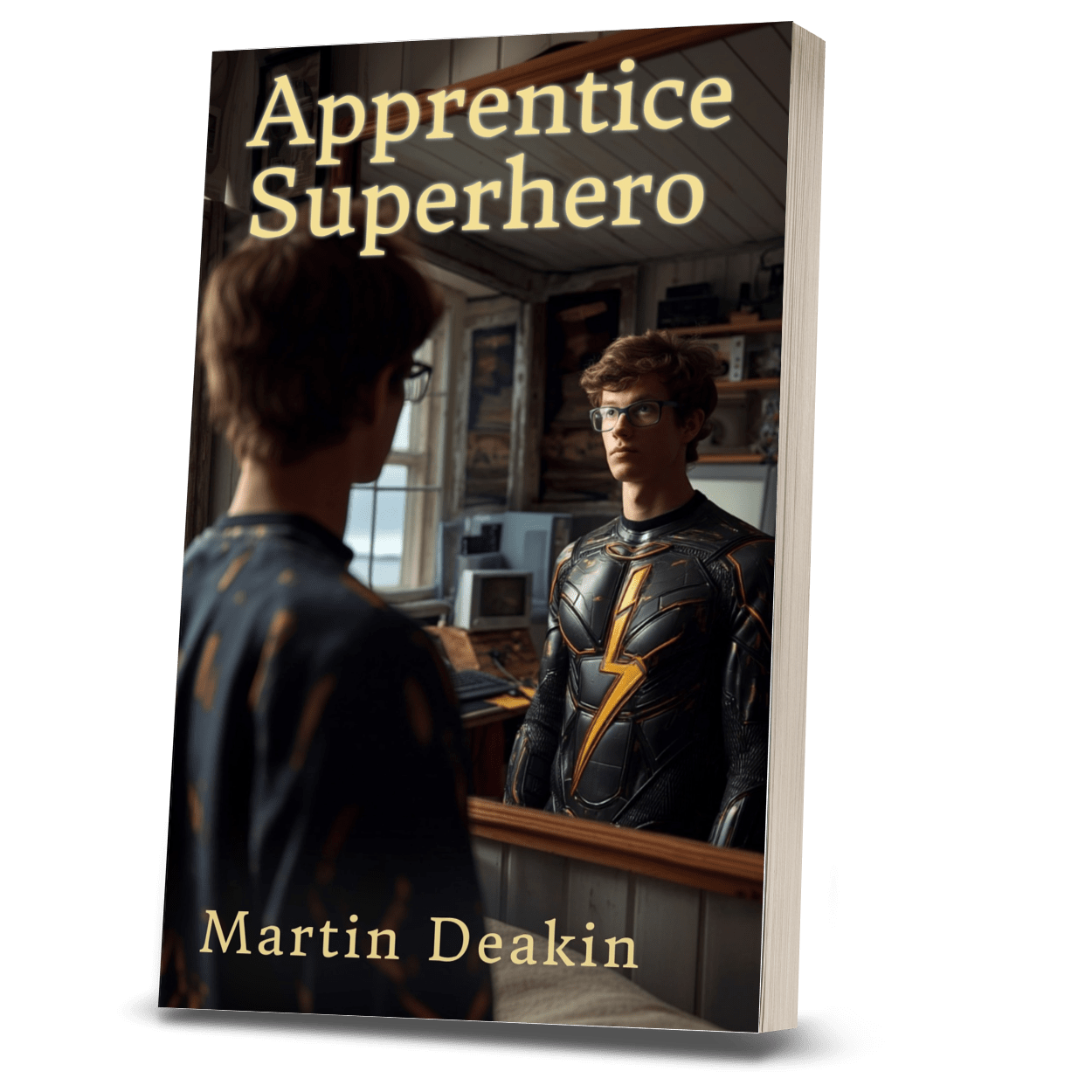
APPRENTICE SUPERHER0
Bleakwinter Farm was once a proud working-class estate. Now it’s a wasteland of crime, corruption, and fear — and Colin’s life is as small and grey as the streets around him. But when a mysterious stranger slips an envelope under his door, everything changes.
Drawn into a hidden war between gangsters and something far older, Colin finds himself apprenticed to a man who can do things that are simply impossible — and what’s more, Merl expects Colin will learn to fight back against the wickedness consuming his world. But how can a boy who’s never won a fight, never kissed a girl, and barely believes in himself become a hero?
At times both funny and dark, heart-warming and human, Apprentice Superhero is a story about courage overcoming cowardice, the ordinary given the chance to become extraordinary.
You will find yourself rooting for Colin, who’s lived running and hiding, to take a leap into the unknown and risk his life being transformed.

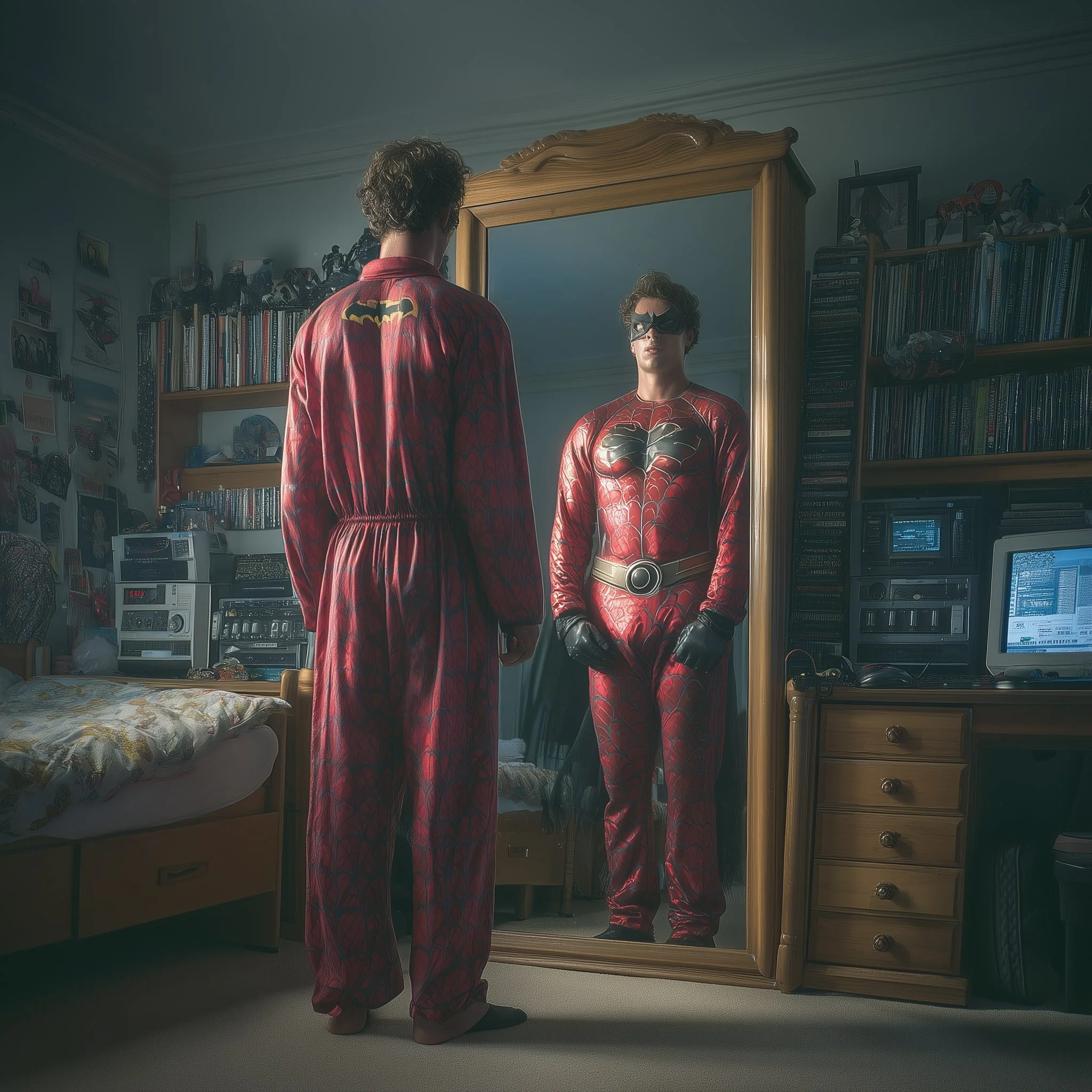
Colin the Apprentice Superhero is for anyone who ever dreamed what they’d do if they woke up one day with superpowers
Scroll down to read Chapter One

Apprentice superhero by martin Deakin.
Chapter One
Colin Cowsbotham lived with his parents on what he dimly remembered as a quiet-ish, upper-working-class street. His memories, though dimmed by the years, were perfectly correct. It had been a pleasant and safe community to grow up in. Back then, but no longer. East Avenue stood at the outer edge of a district that began life as a council housing estate. Some joker in the planning department had christened it ‘Bleakwinter Farm’ but it was known locally as the pit estate. Even long after there was no pit. And after right-to-buy turned council tenants into owner-occupiers.
Once upon a time, as older people still remarked, virtually everyone living there either worked at the pit or in one of the many secondary industries and businesses it supported. At that time, Bleakwinter was irrefutably lower-working-class. What that meant in real money was rough streets with frequent fights outside school and at closing time but no serious injuries from those fights and certainly no deaths nor any likelihood of one.
Full-time employed plus overtime, was how Sergeant Smith, the local bobby at the time, used to put it. Economically speaking. But after the pit closed, Bleakwinter’s terminally wounded economy limped on, each year shedding more and more jobs and businesses until it finally gave up fighting and accepted death. Now the estate had no employment of the PAYE kind, not enough of the cash-in-hand type and far too much of the other kind.
Colin grew up watching the estate decline, deteriorating from proud homeowners tending their gardens and decorating their houses to iron gates, gang tags, Rottweilers, litter-strewn streets and abandoned cars. Colin’s life deteriorated alongside it, from hiding in the library at playtime to hiding at home once the streetlights came on. His parents hid too. Anyone with half a brain did unless they trained at Howard’s Boxing Club. The local police responded to burglaries the following day, at least half the time anyway. Fights at chucking out time didn’t reach their to do list. Serious inter-gang violence, once or twice with guns and a drive by shooting, did. But only rarely, and after having spent resources the police committee described as unsustainable, did charges, prosecution and convictions follow.
At night Colin watched, with his bedroom light off and with the curtains half closed as Audis, BMWs and Subarus screamed up and down the street. The noise didn’t end when the racing did. In the warm weather, parties spilled out onto the street and bass-heavy electronic music spilled out of car doors and boots. Sometimes they’d last until the returning daylight drove them home to sleep the day away until darkness returned and the cycle began again. Through those curtains, Colin had watched, horrified, scenes that haunted him when he tried to sleep. Gang fights, vicious beatings and stabbings. And deaths. From, Colin supposed, overdoses, to which ambulances either arrived too late, protected by three or four police cars, or not at all.On those same grass verges he’d played marbles on what seemed like lifetimes ago. Other scenes he watched prompted feelings quite different from horror. Colin supposed they must be called drug-fuelled orgies. They certainly surpassed anything he’d ever seen when he’d clicked on those icons that popped up when he innocently searched phrases like milk jugs or big dongle. Words that turned out to be double-entendres. Those scenes affected him at night as well, but in a different way.
When Colin’s anger got the better of him and he couldn’t help himself comparing the peaceful retirement his parents had hoped for versus the hell they’d got, he’d load Grand Theft Auto and machine-gun all the criminals down. Then, sometimes, he’d cry. Because that simulated revenge was all that the jeering, swaggering young men and women ruining his parents’, neighbours’ and his own life would ever receive.
Colin’s bedroom was his escape from the outside world. Not only could he completely lose himself online but cyberspace was infinitely safer and more malleable than the cruel real world. He could immerse himself in coding and programming projects so deeply he could stay in there forever — or at least until his numbed backside or cramping calves forced him back into grey reality.
His bedroom also held his physical film and documentary library and his streaming ‘library’, though Colin wondered sometimes if that was the right word.The floor-to-ceiling shelving on two walls was crammed with DVDs, with some, though not many, in their original store-bought cases. Most were from charity shops. Below his worktop, hard drives stored fifty thousand films. Even in such a giant haystack it wasn’t hard to find his favourites. He’d categorised and organised every one into multiple lists. Genre, alphabetical order, lead actor, director, screenwriter and a dozen more.
Colin found it easy to work and play anonymously online. He operated multiple encrypted identities and avatars through encrypted VPNs and IP addresses, never keeping one for too long. Colin’s heroes were Blackhat and Whitehat hackers from his favourite movies. He could quote every line from the Warlock in Die Hard 4, Lyle in the Italian Job remake, Nicholas Hathaway in Blackhat. And Lisbeth Salander in, well, all of them, even the remake that left out the answer to the mystery which drove the whole story.
Online, Colin lived his heroes’ lives — vicariously. He imagined himself living a fully undercover life like Brill in ‘Enemy of the State’, but rather than hiding, like the paranoid Brill, he dreamed he would use his skills to foil crime, expose phishers, scammers and malware writers, investigate cyberterrorists and - his favourite fantasy - emptying the accounts of corrupt politicians and corporations. In those reveries, Colin kept himself securely hidden in his e-castle and just as importantly, safe. Safe from the revenge of those he exposed and whose funds he liberated. Safe too, from real world villains and enemies. In the movies those villains were written as corrupt, lazy and stupid FBI or CIA agents, or in the British ones MI6 operatives or police detectives owned by politicians. Colin detested those characters, workshy sloths whose job titles granted them the power to force hackers to help them, to hijack the skills they didn’t have and couldn’t be bothered to learn. He hated it when the CIA suit threatened the hero with arrest or the Inland Revenue or the Securities or Competition Commission or any number of government-owned ‘regulators’ they could corruptly sick on anyone they wanted. Colin would seethe with anger, then seethe even more that all he could do about it was seethe. At this point he’d remember exactly where seething had got him. In the fifth form, inspired by some film he couldn’t recall, some American high-school coming of age probably, where the bullied hero fights back and wins, he’d called a real school bully a wanker and, spilling over with righteous anger, punched him in the face. Once. Like in the movie. The bully didn’t fall over against his locker, didn’t sit up rubbing his chin, chastened and embarrassed, ever afterwards to respect Colin and work hard to change his bullying ways. Instead, he laughed, insulted Colin’s mother and set about pummelling every inch of Colin’s face and body until a teacher rescued him and walked him, limping, to the school nurse. The experience didn’t reduce Colin’s burning anger by a micron, but it did teach him how to keep the fire banked down low. And to remind him with a stab, even as he seethed through the chink in the curtains at his life on Bleakwinter, that Grand Theft Auto was the closest to real-life violence and revenge as he would ever be capable of.
Once in a while is his daydream, he’d become like Hathaway, not only a hacker but strong, brave and able to fight. A glance in the mirror as he got dressed blew that one away like smoke in the wind. Still, although it was only a daydream, Colin found himself strangely attached to it because Bleakwinter, in fact the entire city, indeed the whole country were as good as doomed unless someone like a superhero appeared out of nowhere. A snappy line from another hacker movie bubbled up. ‘Who else is going to change the world, Greenpeace?’ Except, Colin thought dismally, when the cold light of day dawned, nobody would. Saving the world or short of that, the Bleakwinter Farm Estate, was a pipe dream, like one of Bilbo’s smoke rings that dissolved a few seconds after it entered the real world’s air.